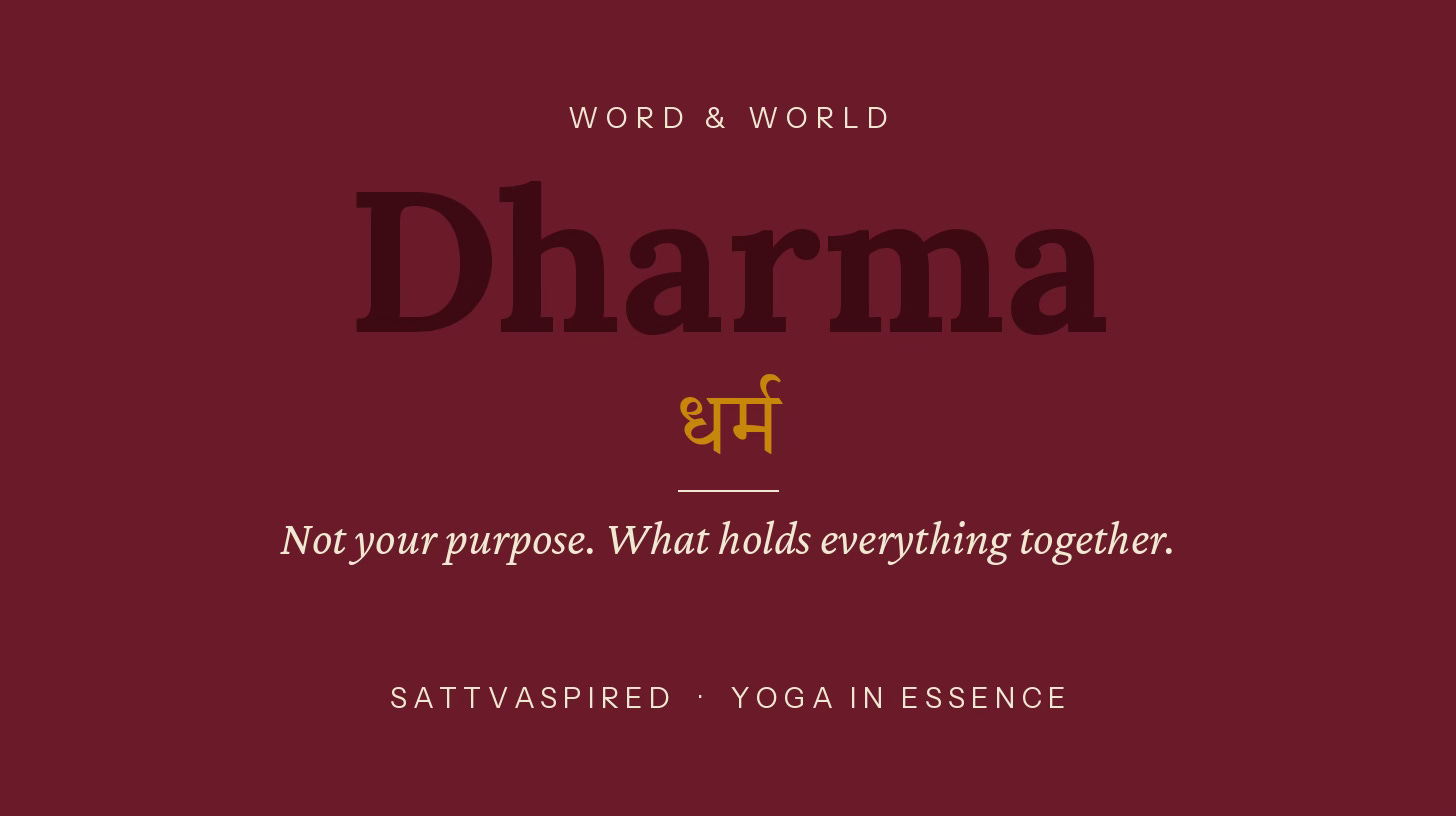
Dharma comes from the root dhṛ to hold, to sustain, to bear. It names what holds things together. Not what you feel called to do. Not your life’s purpose. What sustains the structure of things when beings act in accordance with their nature. This distinction matters because the modern yoga world has inherited a reading of Dharma that is almost entirely personal. Your Dharma. Your calling. Your path. The tradition uses the word at a far wider scale than this, and the personal dimension only makes sense when the wider scales are in view.
Before Dharma, the Ṝgveda gives us a prior concept - Ṛta. It is the cosmic order that underlies all of manifest reality, the way things move when nothing is obstructing them. The sun rises, the seasons turn, the river goes to the sea - none of this is upheld by agreement or choice. It simply is. Ṛta names that inherent order. Dharma is what happens when conscious beings, human beings, in particular bring their action into alignment with it. In the Ṝgveda, Varuṇa is the guardian of Ṛta. He is the one who perceives when the order has been violated, when someone has stepped out of alignment. A ṛṣi who has acted against the order does not go to Varuṇa with arguments or reasons. He goes with honesty, acknowledging what he did, asking to be restored. There is no negotiating with Ṛta. You either move with it or you do not.
This is the ground Dharma stands on. It is not a self-referential system. It does not ask what you want, what you feel called toward, what your intuition says. It asks what the order actually requires given the full picture of who you are, what you have been given, and what this particular moment is asking of you.
The tradition uses Dharma at several levels simultaneously. There is Dharma as cosmic order, the right functioning of reality at every scale. There is universal human Dharma ahiṃsā, satya, honesty, restraint etc the qualities that hold human life together regardless of who you are or where you are born. These are not preferences the tradition happened to develop. They are what a human life looks like when it is functioning in accordance with its nature.
Then there is particular Dharma - what your specific situation requires. Your stage of life, your role, your relationships, what you owe to those around you. This is where sva dharma enters, the Dharma particular to who you are and where you stand.
The Bhagavad Gītā is the tradition’s fullest examination of sva dharma, and it is worth reading carefully rather than through summaries. Kṛṣṇa does not tell Arjuna to discover his calling or act from his deepest truth. He tells him to do what his situation requires even when Arjuna does not want to, even when every instinct in him is moving toward what looks like compassion but is actually a refusal to see his situation clearly. Arjuna’s sva dharma is not self-expression. It is a precise account of what this moment demands from this person in this position. That it is painful is not incidental. The Gītā is not teaching Arjuna to feel more aligned. It is teaching him to see clearly enough to act rightly.
The contemporary reading of sva dharma has moved a long distance from this. Purpose, calling, authentic expression, these are modern categories, not Vedic or classical ones. They place the measure of right action inside the individual. The tradition places the measure outside, in what the order requires, in what your situation actually demands, in what clear-eyed discernment reveals when desire and fear are not distorting the view.
This is why the tradition ties Dharma so closely to viveka, discernment. And why yoga practice, in the classical understanding, is not self-improvement or expanded capacity. It is the refinement of the instrument of perception. Citta vṛtti nirodha that is the stilling of the fluctuations of consciousness, is in the service of seeing accurately. You cannot act rightly if your perception is distorted by attachment, by habit, by the story you have been telling yourself.
The thread that holds it together is this: Ṛta is the order. Dharma is the human response to it. Practice is what makes that response accurate. The three are one architecture. Taking sva dharma out of that structure and reading it as personal purpose does not just simplify the concept. It severs it from the ground that gives it meaning.
At some stage in this journey, we will discuss how Dharma is defined across several Darshana schools, including traditions that later developed into major religions such as Jainism, Buddhism, and Sikhism. We will also explore how Dharma is interpreted in the Itihasas, the Puranas, and the highly influential yet controversial Smriti text, the Manusmriti.
Next in Words & World: Karma - not what goes around comes around, but what the tradition actually means by action and its consequences.
Om Tat Sat
Trupti


Such a great explanation. I very often find myself at a loss in trying to verbalize the idea of dharma especially with a western audience. This greatly helps 🙏🏽
🙏❤️