

In modern discussions surrounding spiritual practice, meditation, and yoga, we frequently treat deep realization as an academic or institutional commodity. We tend to operate under an unspoken assumption: to understand high-level spiritual mechanics, such as the subtle energy channels, the quieted witness-state of the mind, or the internal soundscapes of deep meditation, one must first master dense theoretical frameworks, memorize complex terminologies, or possess formal academic access.
The Indian spiritual tradition offers a radically different, pragmatic perspective: ultimate spiritual reality is fundamentally an experiential science (Anubhava). A Gujarati commentary on Mīrā’s spiritual philosophy states this directly:
પથના ભેદ પથિકો નહીં, પથ-વિવેચકો કરે છે
(Devanagari) पथना भेद पथिको नहीं, पथ-विवेचको करे छे
(Romanized) Path-na bhed pathiko nahi, path-vivechako kare chhe
The differences between paths are drawn by those who analyze paths, not by those who walk them.
When a practitioner deepens their internal practice (Sādhanā), the mechanics of consciousness do not need to be intellectually compiled before they are felt. They unveil themselves organically from within. Because this wisdom is lived, it naturally flows out in whatever language the practitioner speaks. It requires no artificial translation, nor does it depend on specialized technical jargon to validate its authenticity. Nowhere is this phenomenon more clearly illustrated than in the life and poetry of the 16th-century poet-saint Mīrābāī, known throughout this piece by her familiar short form, Mīrā.
Mīrā did not author formal theoretical treatises, nor did she engage in scholarly debates. Yet, her regional devotional songs contain precise, high-level descriptions of advanced yogic states. She did not study these internal states in a library; she articulated them directly from her lived experience. In doing so, Mīrā demonstrated that the deepest states of consciousness are not locked away in academic vaults. They are part of an organic, living tradition that speaks directly to the common seeker.
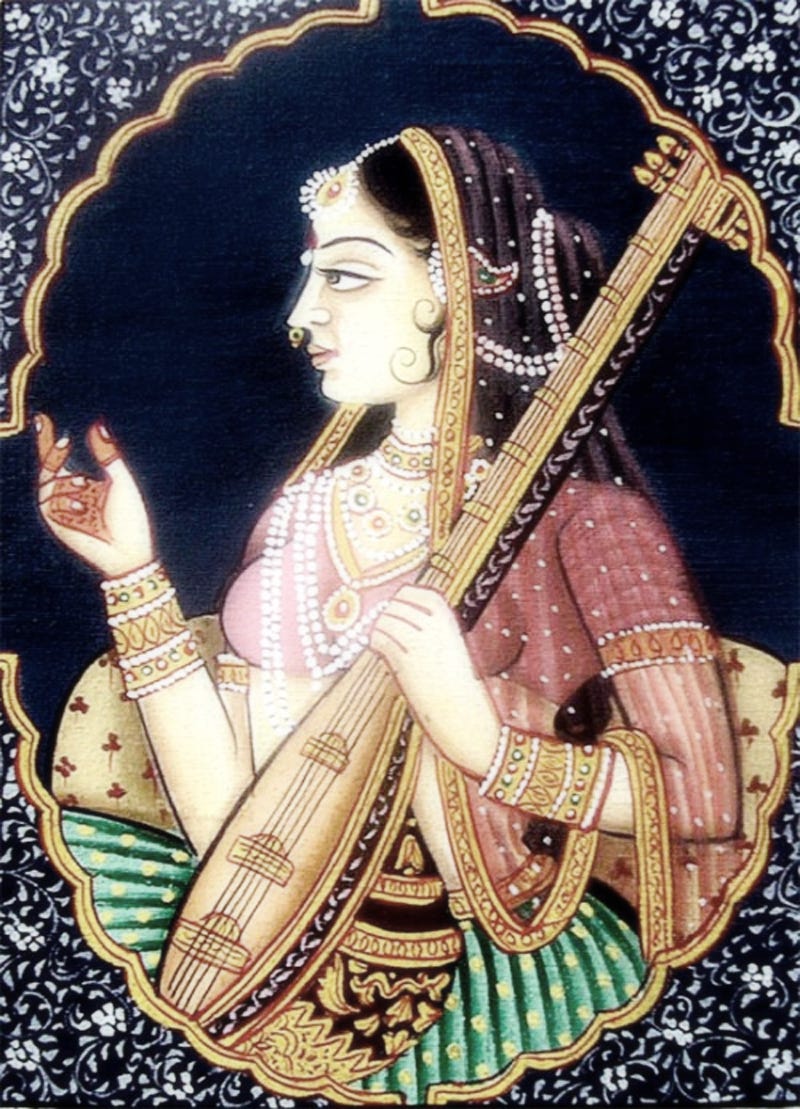
Photo Credit: Meerabai Wikimedia Commons
Deep Dive: Understanding the Terminology: Pad, Pāda, or Bhajan?
While contemporary audiences often refer to Mīrā’s songs as Bhajans (a broad, general term for devotional hymns), in regional literature and classical poetics they are formally categorized as Padas (also written as Pads).
Derived from the Sanskrit Pāda (meaning a verse, stanza, or metric foot), a Pad is a specific short, lyrical poem structured for music and singing in regional dialects (Gujarati, Rajasthani, Braj Bhasha). Unlike long formal epics or technical treatises, Padas were composed in the everyday language of the common populace. Passed down orally across centuries through singers, wandering mendicants, and communal village gatherings (Satsangs), Padas functioned as vital educational vessels. They carried metaphysical insights, subtle yogic maps, and spiritual mechanics directly into the daily rhythms of mainstream society.

