

My uncle handed me this book after Navratri one year one of those gatherings where the house is full and loud and the kitchen never quiets. He said read this, and I did, and what I felt after finishing it was something I could only describe as interesting, which confused me for a long time because everyone else seemed to find it life-changing. Millions of Western readers describe this book as the moment a door appeared that they hadn’t known existed. For me the door was already open. I had grown up inside the world Yogananda was describing, and so his India was not revelation but recognition sometimes very familiar, sometimes a slightly unfamiliar version of something familiar, which is its own kind of unsettling.
What I did not expect was how long the book would stay with me not as an experience but as a question that kept returning: not whether such yogis exist, but whether I was willing to live the way they lived.
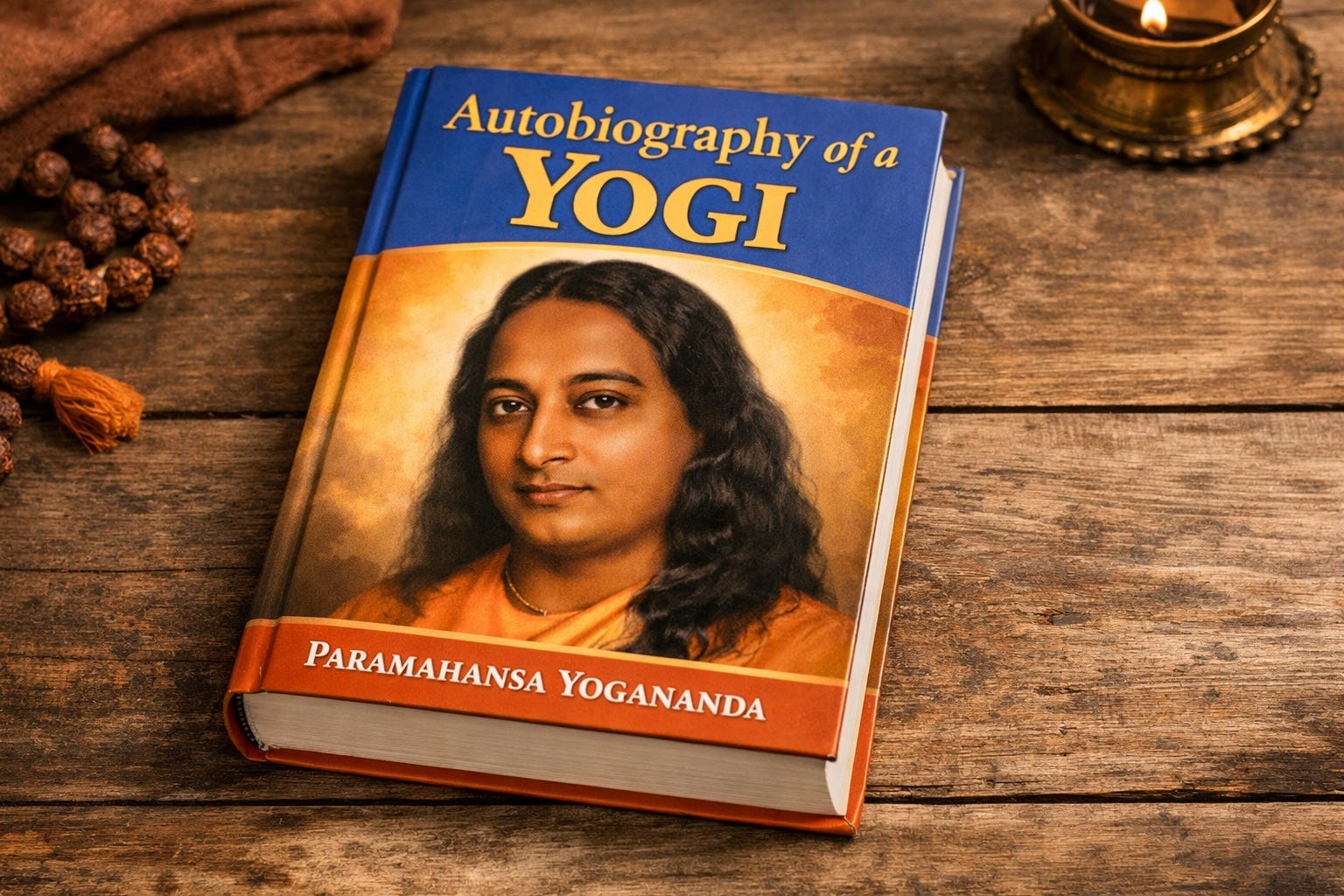
WHAT THE BOOK IS
Autobiography of a Yogi is Paramahansa Yogananda’s account of his own life, his childhood in India, his years of training under his guru Sri Yukteswar, and eventually his journey to America in 1920 where he spent decades bringing Vedantic teachings to a country that had no real framework for them. It covers Kriya Yoga, the science of pranayama and meditation that forms the core of his lineage, and it is populated with portraits of saints, sages, and teachers that Yogananda encountered across India. It is warm, readable, and genuinely unusual part memoir, part spiritual biography, part argument that the inner life of a human being is far vaster than the modern world has accounted for.
It has been in continuous print since 1946, has been translated into dozens of languages, and remains the most widely read account of the Indian spiritual tradition in the English-speaking world. Steve Jobs kept it on his iPad as the only book he had downloaded, and requested it be distributed at his memorial. Whether that tells you something about the book or something about Steve Jobs is a question worth sitting with.
WHAT IT GAVE ME
The section of this book that stayed with me longest is not any miracle, it is the portrait of Sri Yukteswar, Yogananda’s own guru, and the quality of relationship between them. Sri Yukteswar was a householder and a scholar who had studied both Eastern and Western thought with equal seriousness, and he was a teacher of a kind that has become genuinely rare, someone who saw exactly where his students were, including the places they were hiding from themselves, and who pointed at those places without cruelty but also without softening. His love for Yogananda is unmistakable on every page, and so is his refusal to let Yogananda mistake enthusiasm for realisation or emotional experience for genuine understanding.
Yogananda did not attend his workshops. He lived with this man for years was seen by him daily, had no space to perform a version of himself that was further along than he was. That quality of sustained, witnessed practice, where a teacher carries knowledge of your specific patterns of avoidance and the way you deceive yourself about your own progress, is the thing that has nearly disappeared from modern yoga. Every scene between them is worth reading slowly, because together they constitute the most honest portrait of the guru-shishya relationship that I have found in the English language not as an ideal or a concept, but as a lived, demanding, and deeply loving reality.
The other thing this book gave me unexpectedly was a clearer understanding of what the tradition looks like from the outside. Yogananda was writing for a Western audience in 1946, an audience that had no vocabulary for what he was describing, and so he made the invisible visible and the interior dramatic. Reading it from inside the tradition, you can feel where the translation is working and where something is being slightly stretched to cross the distance. That is not a criticism, it is simply what translation costs, and Yogananda paid that cost with enormous skill and evident love for both worlds he was bridging.
WHO SHOULD READ THIS
If you have been practicing yoga for years and have never read this book, read it not because it will teach you asana or pranayama technique, but because it will show you the kind of life the tradition was designed to produce. Not a life of better flexibility or reduced stress, but a life organized entirely around the question of what consciousness is and what a human being becomes when that question is taken seriously all the way down.
If you are from the Indian diaspora and have felt the strange experience of watching your own tradition, be discovered by the world around you, this book is worth reading specifically for that strangeness. Yogananda built a door for the West to walk through into our tradition, and he built it with genuine love, but many of us from Indian families ended up approaching our own inheritance through that same door from the outside having somewhere along the way lost the thread that connected us to what we were born inside. This book can be one way of finding that thread again, not through being convinced of anything, but through recognition.
WHAT IT DOESN’T DO
This book will not give you a practice. It will show you what practice looks like when it has been lived with complete seriousness over many years, but the Kriya Yoga Yogananda teaches is given through initiation, not through reading, and the book itself is clear about this, it is pointing you toward a living transmission, not offering one. If you finish it feeling inspired but without any clearer sense of what to do, that is the book working correctly. The next step is finding a teacher, a lineage, a community something living rather than something printed.
It also will not give you a nuanced account of the broader tradition. Yogananda’s focus is his own lineage and his own path, and while that path is deep and real, the tradition is vast and his book represents one river within it. Read it as an entry point, not as a complete map.
The question my uncle was handing me after Navratri pressed between the covers of a book I was too young to know how to hold was not whether I believed in miracles. It was whether I was willing to do what Yogananda’s teachers did. The practice, the years, the returning when nothing is happening, the allowing yourself to be genuinely known by someone whose clarity is deeper than your own.
I am still finding out. Thirty years after my uncle handed me that book after Navratri, I think that is probably the most truthful thing I can say.
The Library is where I bring books like this : texts that go deeper than the surface of the tradition. If that is the conversation you are looking for, subscribe and stay.
Om Tat Sat.
Wonderfully said. Many misunderstand the guru-shishya relationship. I've read 3 different printings of Autobiography, and seen many reviews of it. Many can't get past the word Autobiography in the title and immediately claim yogananda was a wealthy boy consumed by his own ego, otherwise why would he title his book this way and write about his own life? What Many miss is that Yogananda wasn't rich. His father was poor and worked hard at the railway and has been providing for his family from a small age. His father had minimal belongings and actually gave away more of his money than he spent on himself. As far as the book being a Autobiography it is more than that, it contains info about great saints like Babaji, Lahiri Mahasaya, his wife, and other saints like anandamoyi ma. Originally this book was going to be titled something different but a lot of his disciples feared that it would be misunderstood.
I have many favorite parts of this book, one being the cauliflower robbery. I also enjoyed the Chapter about his student Kashi. So many great things come to us from this work and much much more. Happy to see posts like this from the library. Keep them coming.
beautiful
you have touched beautifully on the point of guru... the joy and the parampara...
the treasure that guides... the eternal quest indeed!