
Stop diagnosing the divine
Why wellness culture keeps turning cosmic principles into nervous-system labels

There is a pattern showing up across yoga teacher trainings and wellness courses right now: take a sacred Sanskrit term, strip out everything it originally meant, and use it as a label for a nervous-system state. Shiva becomes shorthand for freeze. Shakti becomes shorthand for fight-or-flight. Somewhere in the middle, a course gets sold as “ancient wisdom for trauma healing.”
The tools underneath this such as somatic work, trauma-informed movement, aren’t the problem. They have real value on their own. The problem is what happens when you wrap them in Sanskrit and sell the wrapper as the substance. You end up with something that isn’t classical yoga and isn’t clinical trauma care either. It just borrows the authority of both while delivering neither.
To see why that’s a real problem and not just a semantic one, it helps to start with what Shiva and Shakti are actually doing in the traditions that use them.
What Shiva and Shakti actually mean
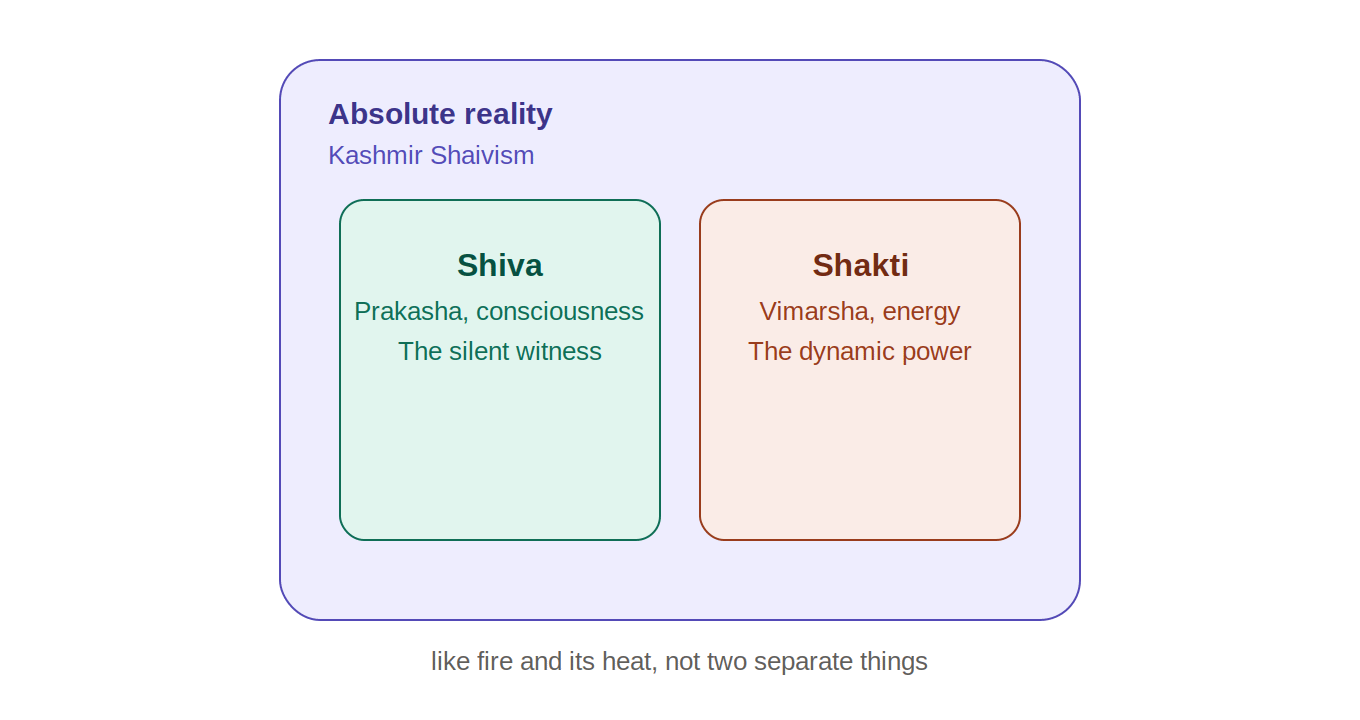
In Kashmir Shaivism and Shakta Tantra- the traditions where this polarity is the central metaphysic : Shiva and Shakti aren’t two forces balancing each other out. They are two aspects of one reality, the way fire and its heat aren’t really separate things.
Shiva is Prakasha : unattached, unchanging consciousness. The silent witness behind everything. Shakti is Vimarsha: the dynamic power through which that consciousness manifests, sustains, and dissolves the world. One is stillness, the other is the capacity to become anything at all and neither exists without the other.
Worth being precise about where this framework actually lives, since precision is the whole argument here. Samkhya doesn’t use Shiva and Shakti at all; its categories are Purusha and Prakriti. Advaita Vedanta centers on Brahman and Maya, and while it acknowledges Shakti as Brahman’s inherent power, it doesn’t organize itself around a Shiva-Shakti pairing. The Prakasha-Vimarsha language specifically comes out of Kashmir Shaivism, from thinkers like Utpaladeva and Abhinavagupta. So this isn't "classical yoga philosophy" in general, it's the specific vocabulary of one school. That's already wrong before trauma theory even enters the picture.
And here is what none of the source texts do with it. Not the Yoga Sutras, not the Hatha Yoga Pradipika, not the Shiva Sutras or the Spandakarika. None of them use Shiva and Shakti to diagnose a psychological state. There is no verse defining “over-Shiva” as perfectionism or emotional shutdown. No passage treating “over-Shakti” as burnout or urgency. These are cosmic principles describing how the universe comes into being, collapsing them down to coping mechanisms doesn’t modernize them, it just misreads what they were ever talking about.
Pure consciousness doesn’t have a trauma response.
How the substitution actually works
So how does a course end up calling this “trauma-informed Shiva-Shakti yoga”? The mechanism is pretty simple once you see it. Take the real clinical vocabulary - polyvagal theory, somatic experiencing, the fight/flight/freeze/fawn language that comes out of 20th-century Western psychology and swap the terms. “Parasympathetic shutdown” becomes “Shiva.” “Sympathetic overdrive” becomes “Shakti.” Then market the result as ancient wisdom, or as “textually accurate classical yoga.”
Call it dharma-coating: using sacred vocabulary as a finish coat over something else entirely. It shortchanges everyone involved. Students looking for classical yoga get a rebranded version of Western therapy instead. Students who actually need trauma support get an instructor who now sounds qualified to hold real psychological wounds because the Sanskrit lends a kind of borrowed authority that a 50 hour certificate wouldn’t earn on its own. That borrowed authority is exactly where the risk starts.
Where this actually causes harm
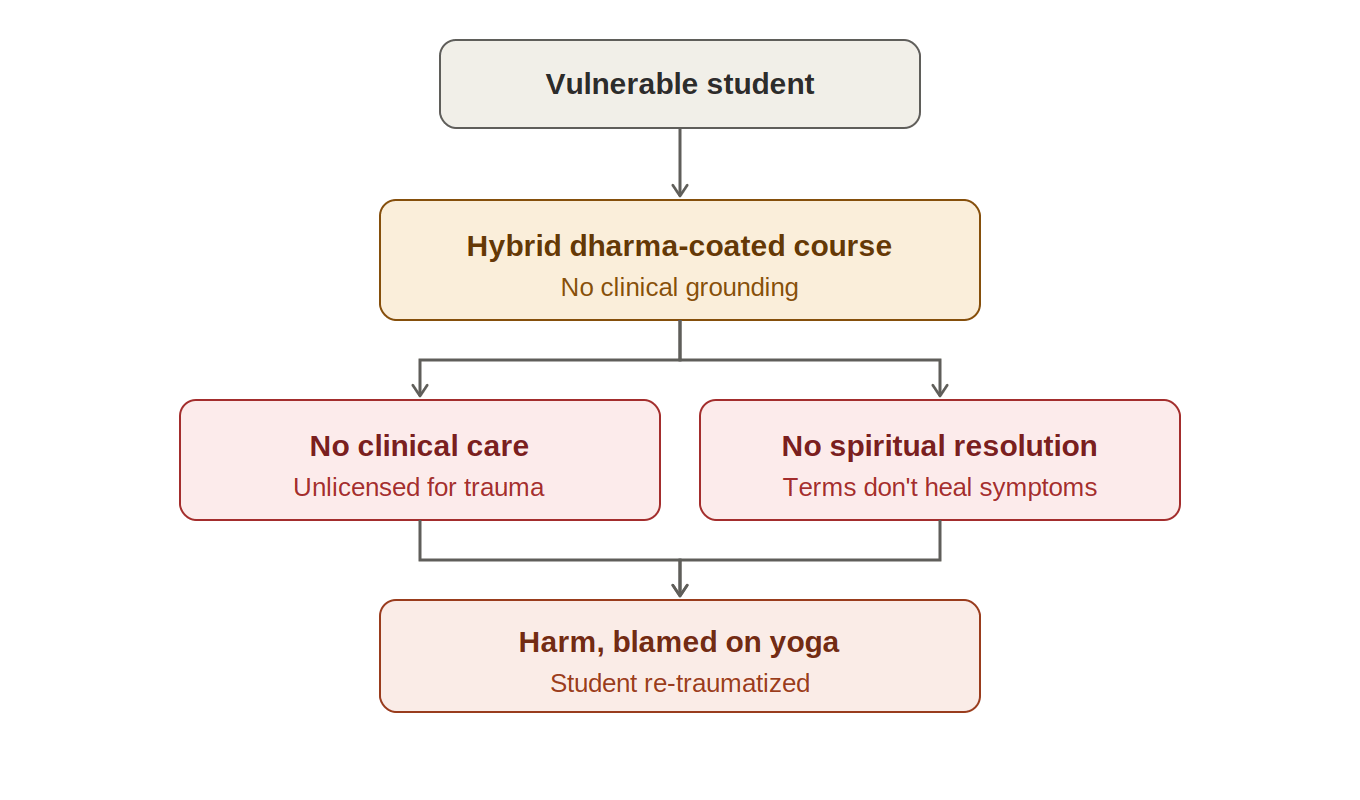
Trauma work takes years of clinical training, supervised practice, diagnostic skill, the kind of expertise licensed psychologists and certified somatic therapists spend a career building. A short course on “Shiva, Shakti, and trauma” doesn’t produce that. It produces a vocabulary. And handing someone a vocabulary instead of training, then pointing them at students with severe PTSD or developmental trauma, is genuinely dangerous not as a hypothetical, but as a foreseeable outcome of the setup itself.
Here's how it plays out. A student with real clinical trauma gets told their nervous system freeze is an "over-Shiva imbalance." They don't get clinical intervention, because the instructor isn't trained to give it. They don't get traditional spiritual practice either, because that was never really on offer — the Sanskrit was doing marketing, not teaching. When the framework fails to resolve something that deep, the failure gets pinned on "yoga."
The Sanskrit was doing marketing, not teaching. Critics point to the story and say yoga is unsafe, yoga fails trauma survivors, when what actually failed was never yoga at all. It was a pseudo-therapeutic hybrid wearing yoga's name.Telling the real thing from the marketing
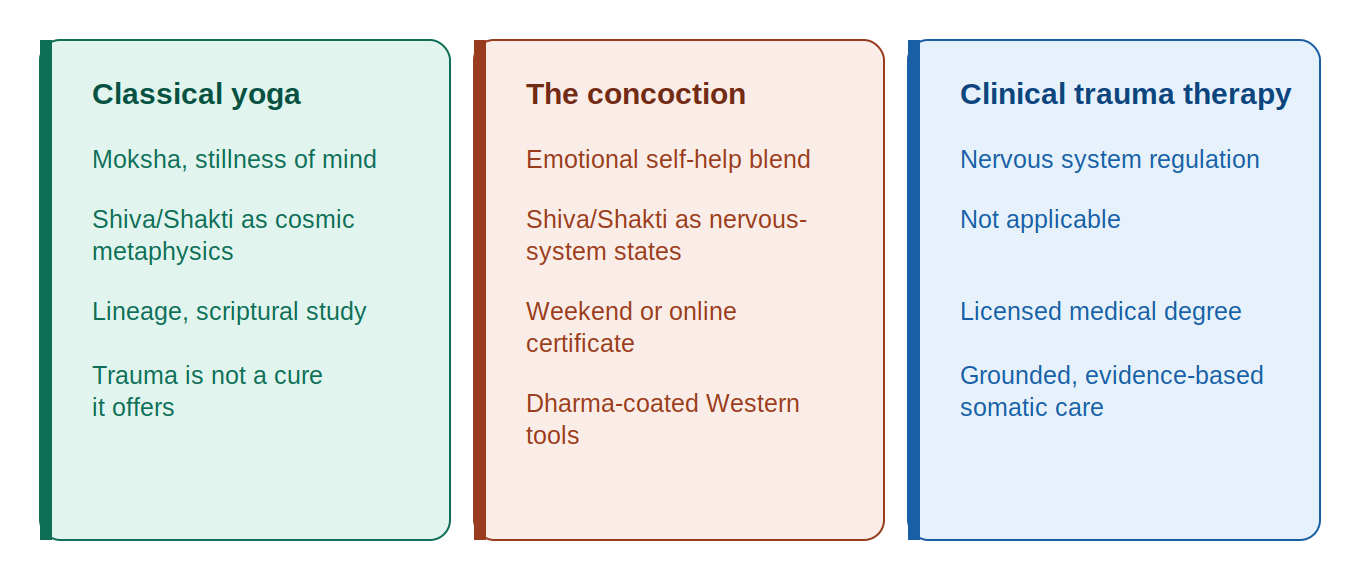
Line these three up side by side and the difference stops being subtle. Classical yoga is aimed at moksha, treats Shiva and Shakti as cosmic categories, and requires years of lineage-based study - trauma relief was never its promise to begin with. Clinical therapy is aimed at nervous-system regulation, has nothing to do with Shiva and Shakti at all, and requires an actual license. The concoction sits in between, borrowing the vocabulary of the first and the promise of the second, backed by neither’s training. That gap is the whole risk. Blending traditions isn't inherently wrong. This particular blend just hides how little real training actually stands behind it.
Where that leaves things
Modern trauma-informed movement has real value. Classical Indian metaphysics has real depth. Neither needs to borrow from the other to justify itself, and mashing them together doesn’t strengthen either one, it just obscures what’s actually being offered.
Trauma care needs real clinical training. Classical yoga needs real engagement with its texts and its actual goals which were never about nervous-system regulation in the first place. Let each stand on what it actually is. Sacred names aren’t marketing hooks, and a nervous system in crisis deserves more than a Sanskrit label.
I know I am not the only one who's noticed this. If you've seen it too, I would love to compare notes.
Love, love, love this so much!
This was really well done. Thank you for sharing