

You wake up at 6am. Roll out your mat. Move through your sun salutations. Post a photo. Caption it: morning practice.
And somewhere in the back of your mind, you call yourself a yogi.
There is nothing wrong with any of that. The mat is a beginning. The body is a doorway.
But there was a boy in Tamil Nadu in 1896 who never once stepped onto a mat. Who never learned a single asana. Who had no teacher, no lineage, no certification, no Instagram. Who simply lay down on a floor one afternoon, convinced he was dying and asked, with total sincerity, one question.
Who am I?
What happened next changed the course of modern spirituality. And it has something very direct to say to anyone who has ever called themselves a yogi.
An Unremarkable Boy in an Indian Household
He was not, by any early account, destined for greatness.
Venkataraman Iyer was born on December 30, 1879, in the small town of Tiruchuli in Tamil Nadu, the second of four children in a middle-class Indian family. His father, Sundaram Iyer, was a pleader, a kind of uncertified local legal practitioner. His mother, Alagammal, was pious in the customary domestic way. The household was ordinary, observant, and unremarkable.
At school, Venkataraman was neither a prodigy nor a mystic. He was physically robust, fond of wrestling, and had the peculiar gift of falling into a deep, almost unrousable sleep the moment he lay down, a sleep so total that his friends would carry him from one place to another while he felt nothing. He did not meditate. He had heard of Arunachala, the sacred hill in Tiruvannamalai associated with Lord Shiva in the way Tamil children hear of holy places: as geography, as custom, as somewhere elders spoke of with reverence. He felt it was vast and real, though he could not have explained why.
In 1891, his father died unexpectedly. Venkataraman was sent to live with an uncle in Madurai. He enrolled at Scott’s Middle School and then the American Mission High School. He was sixteen years old, academically average, entirely unaware that he was six months from the most decisive hour of his life.
The Death That Did Not Kill Him
In July 1896, without warning and without cause no illness, no grief, no external trigger that he or later scholars could identify Venkataraman was seized by a sudden, overwhelming certainty that he was about to die.
He was alone in his uncle’s house on the upper floor. The fear was total and physical, not the abstract awareness of mortality that most people carry at a distance. This was immediate. He felt that death was arriving now. His body went rigid. He lay down on the floor and stretched out his limbs as if in a corpse.
He later described what happened:
I held my breath and kept my lips tightly closed so that no sound should escape. I enquired within myself, steadily, keenly: what is it that is dying? This body dies. But does ‘I’ die?
What happened in the next few minutes became one of the most examined moments in 20th-century spiritual biography. Lying still, pretending to be dead, Venkataraman investigated the question with a ferocious, spontaneous lucidity. The body would die that was certain. But was there something that watched the body? Something that could not be found when he looked for it, and yet was undeniably present as the very act of looking?
The “I” could not be located in the body, the breath, or the mind. And yet it was there indestructibly there as the ground of all experience.
In less than half an hour, the experience was complete. He rose from the floor. The fear of death had been annihilated not by reassurance or philosophy, but by the direct recognition that whatever he fundamentally was could not die. He later called it Ātma Sākshātkāra, direct realization of the Self. He was sixteen. He had not been taught this by any teacher. He had not read the Upanishads. He had done nothing except lie down and ask.
Notice what he did not do. He did not breathe in a particular pattern. He did not hold a posture. He did not chant. He simply turned attention back on itself completely, honestly, without escape. And that was enough.
The Escape to Arunachala
For the weeks following the death experience, Venkataraman remained in Madurai but was transformed. He had no interest in food, in friends, in studies. Teachers reprimanded him. His older brother Nagaswami, noticing his strange detachment, snapped: “What use is all this to one of your sort?”
The remark crystallized something. On September 1, 1896, Venkataraman told his family he was going to school. He was not. He took three rupees, left a brief note explaining he was going in search of his Father meaning the divine, meaning Arunachala and walked to the Madurai train station.
He was sixteen years old. He had no return plan. He would never live with his family again.
The journey to Tiruvannamalai took three days. He sold his earrings at one point to cover the fare. He walked much of the way. He arrived at the great Arunachaleswarar temple one of the largest Shiva temples in South India, built over centuries at the foot of the hill and wept. He had arrived, as he later put it, at his Father’s house.
He shaved his head, threw his remaining money into a temple tank, and discarded his upper cloth. From this day forward, for the rest of his fifty-four-year life, he never left Arunachala. Not once.
The Silent Years in the Caves
The early years at Arunachala were years of silence so absolute that it is difficult, from a century’s distance, to fully imagine.
Ramana, as he came to be known settled first in the thousand-pillared hall of the temple, then in various shrines on the hill itself. He sat in samādhi for hours and days at a stretch. He ate whatever was placed before him, or nothing. He barely spoke. He was indifferent to his body to a degree that alarmed those around him: insects bit him until his legs bled; he did not move. He sat in the underground pit of the Patala Lingam shrine for weeks.
A devoted attendant named Pazhaniswami found him and began caring for him reading aloud from Tamil scriptures, which Ramana absorbed with recognition rather than learning, since he had not studied these texts formally. When devotees eventually brought him the classical Advaita Vedanta texts the Yoga Vasistha, the works of Adi Shankaracharya, he confirmed what he already knew from direct experience. The texts were maps; he had already arrived at the territory.
By the early 1900s, he had moved to Virupaksha Cave on the southern slope of Arunachala, where he would remain for over seventeen years. A small community formed around him not because he recruited anyone, but because seekers found him and could not leave. He answered questions. He composed Tamil poetry. And at a devotee’s request, he wrote the text known as Nān Yār? Who Am I?- a lucid, spare exposition of the method that had delivered him from death-fear at sixteen.
The Teaching: Self-Inquiry as the Direct Path
Ramana’s teaching was, philosophically, a single point.
There is only one thing worth knowing: the nature of the Self. And there is only one reliable method: trace every experience, every thought, every sensation back to its source by asking “Who is experiencing this? Who is thinking this? Who am I?”
This is not a philosophical question. It is a gesture of attention, a turning of awareness back on itself. Most spiritual paths involve the mind working on objects: concentrating on a deity, analyzing a scripture, controlling the breath. In all such practices, the practitioner remains as a subject working on an object. Self-inquiry Ātma Vichāra dissolves the subject-object structure itself.
The inquiry “Who am I?” cannot be answered by the mind because the mind is itself one of the objects being examined. If sustained, the inquiry plunges awareness back into its own source the silent, undifferentiated ground he called the Self, the Heart, or simply Sat-Chit-Ānanda: Being-Consciousness-Bliss. He acknowledged other paths devotion, service, breath-control, mantra. But he consistently returned to self-inquiry as the most direct: “Other methods involve retaining the mind. This method alone cuts to the root.”
The Self, he insisted, is not something to be attained. It is what you already are.
Consider that for a moment, you on your mat. Every practice you have ever done, every breath, every posture, every moment of stillness has been preparing the instrument to receive that recognition. Not to earn it. Not to build toward it. Just to be quiet enough to see what was never absent.
The Ashram, the Visitors, and the World
Ramana’s mother, Alagammal, had spent years searching for him after his disappearance in 1896. She found him eventually and pleaded more than once for him to return home. He did not. But her presence softened him or rather, revealed a tenderness that had always been there.
In 1916 she came to live at Arunachala permanently. She died there in 1922, with Ramana present, his hand placed on her heart not in grief but in the tradition that understood a guru’s touch at death as an act of grace. He buried her at the foot of the hill. Over her grave, a small shrine was built. That shrine became Sri Ramanasramam, the ashram that today receives hundreds of thousands of visitors annually. Ramana had not founded it. It had formed around him, as everything in his life had, without plan or ambition.
By the 1930s and 1940s, visitors arrived from across the world.
The British writer Paul Brunton visited in 1931, spent weeks in the ashram hall, and wrote A Search in Secret India - the book that introduced Ramana Maharshi to the English-speaking world. He wrote of sitting in Ramana’s presence:
My questions, which had seemed so urgent in Bombay, seemed foolish now not because he had dismissed them, but because they had stopped mattering.
The novelist W. Somerset Maugham visited and later based the character of the silent sage in The Razor’s Edge on Ramana. Carl Jung corresponded about him with admiration, though he never visited. The philosopher Heinrich Zimmer wrote about him at length.
In the large open hall of the ashram that was accessible to anyone who came a characteristic scene repeated itself for decades: seekers arrived with elaborate questions, theological quandaries, personal anguish. Ramana would look at them. Sometimes he answered. Sometimes he was silent. Most visitors reported that sitting in his presence was itself the answer that the questions dissolved before they could be properly asked, not because of anything he said, but because of something communicated in the silence itself.
Cancer and the Mahasamadhi
In 1948, a small tumor appeared on Ramana’s left arm. Doctors diagnosed it as a sarcoma-malignant cancer. Four operations were performed. Each time the tumor returned, more aggressive. His devotees wept openly in the hall.
Ramana’s response was characteristic: quiet, almost amused, utterly undefended.
“Why are you all so distressed?” he asked his weeping attendants. “The body is the disease. The Self is not ill.”
He continued to sit in the hall. He gave interviews when his energy permitted. Pain was visible; suffering was absent. On April 14, 1950, Tamil New Year devotees gathered in the garden outside his room and began singing Arunachala Shiva, the hymn he himself had composed decades earlier. At 8:47 in the evening, those in the room saw his eyes fill with light. His breathing became shallow, then still. A large shooting star was widely reported across Tiruvannamalai that night, arcing over the hill of Arunachala.
He was seventy years old. He had not left the hill in fifty-four years.
What Remains And What It Asks of Us
The mat is real. The practice is real. The discipline of showing up, day after day, to move and breathe and be present that is not nothing. The great traditions have always honored the body as the first temple.
But Ramana’s life asks a quiet, uncomfortable question of anyone who stops at the mat:
Have you asked yet?
Not in the philosophical, someday sense. Right now. In the middle of your warrior pose, in the breath before savasana, in the stillness after the last sun salutation who is the one doing all of this? Who is aware of the body moving? Who watches the mind congratulate itself on a good practice? The postures were always meant to prepare the nervous system for that question. The breath was always meant to thin the wall between the surface self and the deeper one. The mat was always a runway, not a destination. Ramana never needed the runway. Most of us do. That is not a failure, it is the path working exactly as it was designed. But at some point, the path asks you to look up from the mat and ask what he asked at sixteen, alone on a floor in Madurai, with no preparation except total honesty:
Who is doing this? And who is the one who wants to know?
That question, held sincerely, is where yoga in its original, complete sense actually begins.
If this story stirred something in you a question, a stillness, a sense that your practice might be pointing somewhere you haven’t looked yet that is exactly why I write.
This publication exists for practitioners who are ready to go deeper. Subscribe to keep going.
Om Tat Sat
Trupti | SattvaSpired, Yoga in Essence
Sources & Further Reading: Ramana Maharshi, The Path of Self Knowledge by Arthur Osborne · A Search in Secret India by Paul Brunton · Who Am I? by Ramana Maharshi (available free at sriramanamaharshi.org) · The Collected Works of Ramana Maharshi.
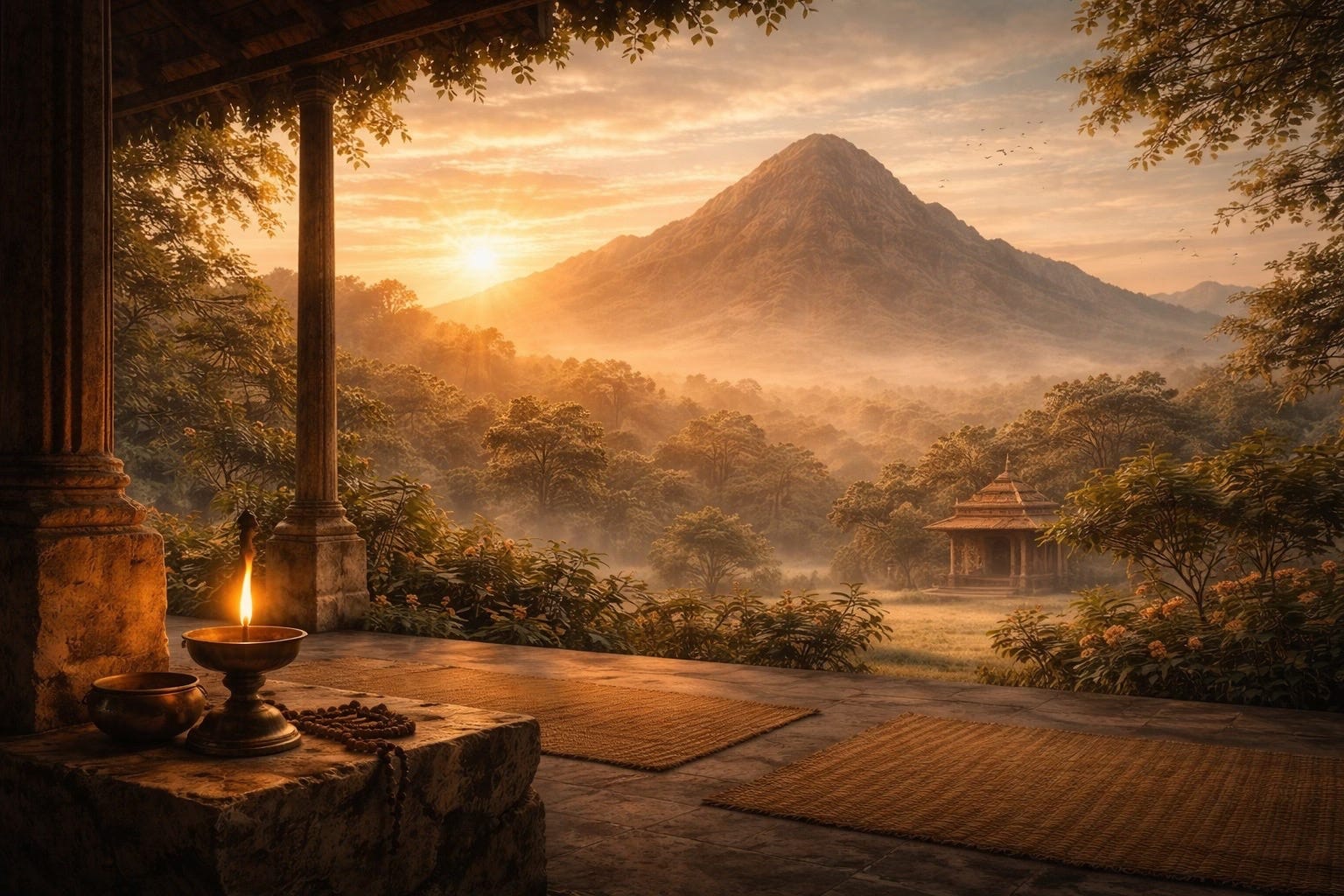
Image: AI generated.
Errors or corrections welcome, reply to this post or leave a note in the comments.
Captured the transition from the ‘physical’ runway of asana to the internal ‘destination of self. Bravo I love this article.
Thank you for this writing. So much shines through it, and it helped me see more of his life's story. He's such a gem 🙏