

If the story has to be bent for you to buy yoga, maybe yoga’s not what you’re buying.
Distorted Stories as Bait
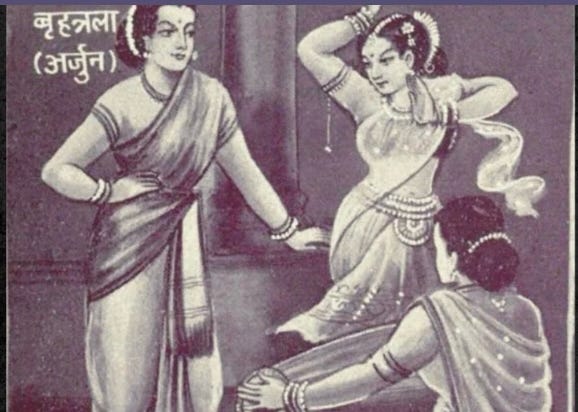
A few weeks ago, scrolling through my feed, I paused at a post about Arjuna, the legendary warrior from the Mahābhārata. The post was striking: it claimed Arjuna was a nonbinary figure who “embraced his femme form” during exile, living as Brihannala. The image was polished, the language moving, the message uplifting. It framed Arjuna’s story as evidence that queer and gender-nonconforming identities have always been part of yoga’s lineage. The post was part of a wider trend, a movement to celebrate “Yoga Misfits,” ancient rebels whose stories are reinterpreted through modern identity politics, inviting marginalized seekers to see themselves reflected in the yogic tradition.
It sounds radical. Inclusive. Brave. But the moment I saw it, I felt a familiar pang. Because I knew the story wasn’t true.And more than that, this wasn’t yoga.
The story you’re told and the story behind the story
The Mahābhārata is one of the richest spiritual epics humanity has ever produced, filled with complex characters, deep philosophy, and spiritual depth. But these days, when ancient stories are folded into contemporary identity narratives, something important gets lost.
Let’s look closer at Arjuna’s Brihannala episode, the heart of this distortion.
In the original text, Arjuna faces a curse from the apsara Urvaśī. She had approached him with romantic intent, but Arjuna respectfully rejects her advances because he views her as a mother figure, she is connected to his ancestors, and accepting her would be against dharma. Offended, Urvaśī curses him to lose his masculinity for a year.
What does Arjuna do? He accepts the curse with calm dignity.
Why? Because the final year of the Pāṇḍavas’ exile demands that they live incognito, hiding their true identities. Arjuna adopts the identity of Brihannala, a dance and music teacher to Princess Uttara, as a practical strategy to protect his family and fulfill their vow.
There is no mention of an inner gender awakening.
No celebration of queer or nonbinary identity.
No rebellion against social norms.
What is present is dharma: duty, sacrifice, self-control, and cleverness.
Arjuna sets aside his ego, not to express himself, but to serve something larger than himself. This is yoga.
Why does this matter now?
You might wonder, why does it matter if modern teachers interpret this story differently? After all, stories evolve, and many traditions retell tales to find new meaning.
But this isn’t just reinterpretation. It’s distortion.
These reframed narratives are bait, specifically designed to attract well-meaning seekers and teachers, those disconnected from the source culture, into workshops, retreats, online courses, and social media circles. These spaces promise belonging, moral virtue, and a comforting sense that yoga fits neatly with current waves of activism and social identity.
It feels inclusive. It feels rebellious. It flatters your self-image while soothing your conscience. But it’s a curated product not a spiritual transmission. When you package yoga this way, you risk turning a profound, lived tradition into a trend something to be consumed rather than practiced.
Who pays the price?
The cost of this distortion falls hardest on the sincere seeker.
Imagine a student passionate about yoga philosophy. They spend years studying, practicing, maybe even training to teach. They want to honor the roots but all they see are filtered versions, catchy slogans, and half-truths reshaped to fit Western comfort zones. This student ends up with an incomplete, often misleading understanding. They miss the discipline, the devotion, the surrender that real yoga demands. Instead, they receive a simplified, feel-good story that never challenges them. The teacher who tries to convey depth but has only surface knowledge is at a disadvantage too. Without solid grounding, their guidance becomes a performance, well-meaning but shallow.
And the culture that gave us yoga? It gets erased. Its complexity and sacredness flattened for marketability.
What Brihannala really teaches us
Brihannala’s story is a quiet but powerful lesson.
It teaches self-containment over self-expression.
It shows the strength in surrendering ego for dharma’s sake.
It reminds us that sometimes yoga asks us not to shine, but to hide our light for a time so that vows, duties, and greater plans can be fulfilled.
Arjuna’s time as Brihannala was not about embracing an identity to be celebrated or performed. It was a strategic act of restraint, a tapasyā (penance) that embodies yoga’s deeper purpose. In this, yoga transcends identity politics, it embraces all beings through the spiritual path, not through slogans.
Yoga is not a hashtag to remix
This repackaging of sacred stories with contemporary labels is a growing business. Add a Sanskrit phrase here.
Add a heartfelt backstory there.
Promise “belonging” and “liberation.”
And suddenly, you have a market-ready narrative that comforts seekers while erasing origins. It looks radical. It feels healing. But it is a curated product, designed to comfort rather than transform.
The Real Story Is Enough
The Mahābhārata doesn’t need your edits to be relevant. Yoga doesn’t need trendy hashtags to be inclusive. Arjuna doesn’t need to become a gender icon for you to belong. Yoga has always made space for all, not through slogans but through dedicated study, and the sacrifice of ego. So let’s stop flattening vast texts into brand campaigns. Let’s stop rewriting our way out of discomfort. Let’s keep the door wide open for sincere seekers but keep the roots intact. You don’t need the “misfit” label to belong. You need honesty with yourself, with the text, with the tradition. Some things don’t need a new story. They need to be practiced as they are.
Final Reflections
Yoga is an invitation to transformation not comfort. It asks us to look beyond our identities, our politics, and even our stories, to find something universal.
The So next time you see a trendy retelling that feels too neat or too comforting, pause. Ask: Is this yoga? Or is this a story bent to fit a trend?
The Brihannala episode invites us to practice surrender and discipline in a world that increasingly demands expression and performance. This tension is where real yoga lives.
Because if the story has to be bent for you to buy yoga, maybe yoga’s not what you’re buying.
If this spoke to you, please share it and help keep yoga connected with its roots.
🌿 Join the movement: sattvaspired.substack.com
🌿 Follow on Instagram: Trupti
Disclaimer:
This article critiques patterns of ideological distortion and commercialization within contemporary yoga spaces.Any resemblance to specific individuals or programs is coincidental and intended only to highlight broader industry trends.This is a cultural and philosophical analysis grounded in reverence for Sanātana Dharma not a personal critique.
Thank you so so so much for writing about this!
When I started to read this...my immediate question was how are gender identitied and yoga related? Why even bring a distorted story into the picture?
Please correct me if I'm wrong...but people often get confused between yoga and yogic traditions...which are sort of inter-related but still different.
You're absolutely right. It's a massive disservice to the person learning this...it's even worse when they start teaching others the same thing.
Words are immensely powerful. They hold frequency and energy. I hope people use it right.