

A few days ago, I came across a post about a “Yoga Misfits” retreat/training: a well-meaning idea, offering a space for people who feel excluded by today’s commercial yoga world. But what caught my eye was the way it used Mirabai - the 16th-century Bhakti saint, as its symbol of rebellion.
In that version, Mirabai was described as a fierce spiritual rebel, defying patriarchy, breaking social rules, and claiming her freedom through dance and song. It was a neat story. But it missed the real one.
Who Mirabai actually was
Mirabai was born around 1498 in Kudki, near Merta in present-day Rajasthan. Her father, Ratan Singh Rathore, was a respected Rajput noble connected to the royal house of Mewar. After her father died, she was raised by her grandfather, Rao Dudaji, who was a committed Vaishnava devotee of Lord Krishna.
Mirabai’s devotion did not appear suddenly as an act of rebellion in adulthood. It shaped her entire childhood. According to accounts preserved and retold by traditional lineages, Mirabai’s bond with Krishna began when she was still a small child.
A visiting saint once stayed with her family and brought with him a beautiful idol of Krishna. The young Meera was so drawn to it that she asked for it. The saint refused, but that night he dreamed that Krishna told him to hand the idol over to the child. The next morning, the statue became hers. From that day on, Krishna was not just an image for Mirabai, he was a living presence she dressed, decorated, talked to, and offered her daily life to as worship.
A life of Bhakti — not defiance
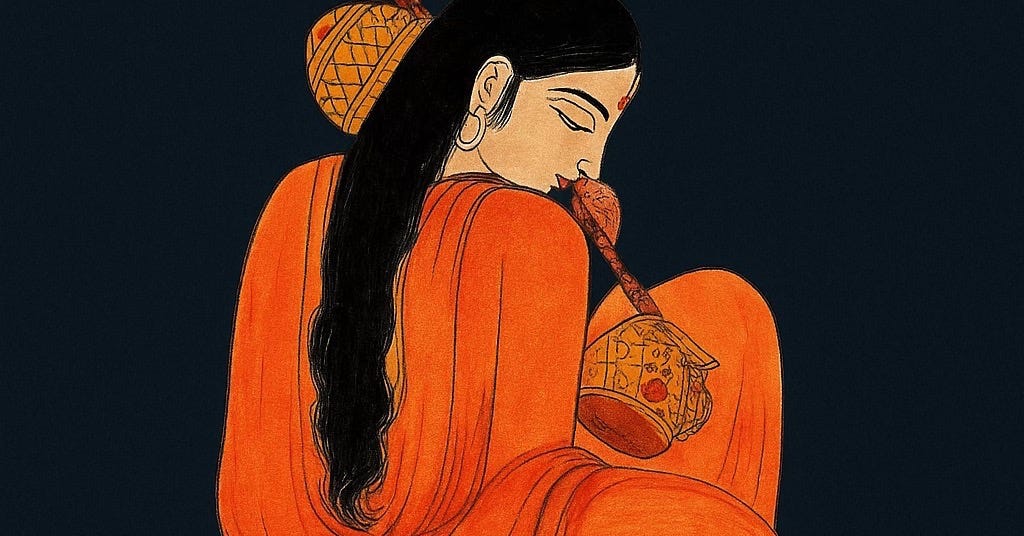
Even as a child, Mirabai built a miniature temple for Krishna, bathed and dressed the idol, decorated him with flowers and jewelry, and spent hours singing and dancing for him while playing her ektara - a simple one-string folk instrument.
Later, she accepted Saint Raidas, a saint and disciple of Ramananda, as her guru. Saint Raidas was a cobbler (Chamar, a Shudra community). It was he who gave her initiation with the name Rama. Some found this unusual since Meera’s poems mostly praise Krishna, but in the Bhakti tradition, Krishna and Rama are not separate deities competing for loyalty. They are both forms of the same Supreme Reality.
Mirabai’s devotion to Raidas shows that not only she, but all sincere seekers in her time, did not let caste or social rules stand in the way of receiving true knowledge and guidance. She did not campaign to reform society, nor did she rally others to demand access to Raidas. She simply followed her guru with full surrender, showing by example that Bhakti dissolves all social divisions when the heart is true.
Mirabai herself wrote verses that explain this directly. In Payoji Maine Ram Ratan Dhan Payo (पायो जी मैंने राम रतन धन पायो), she calls the name of Rama the greatest treasure her guru gave her, the jewel that made her his own forever.
Marriage — and freedom within it
One popular claim is that Mirabai’s life is an example of rejecting arranged marriage to live on her own terms. The real story is more subtle and more powerful.
As a young girl, Mirabai once saw a wedding procession and asked her mother who her own husband would be. Her mother, perhaps lightly or perhaps deeply, told her that Krishna was her true husband. This became Mirabai’s deepest conviction. But to maintain her family’s standing, she was married young to Prince Bhoj Raj, heir to the throne of Mewar.
Far from imprisoning her, Bhoj Raj understood that Mirabai’s love for Krishna was not an ordinary religious habit. He gave her the freedom and protection to live as she chose. He allowed her to host saints, sing bhajans, and spend hours in Krishna’s temple. The same was true of her grandfather and father before him.
After Bhoj Raj passed away, however, Mirabai’s brother-in-law, the new Rana of Mewar, did not share the same acceptance. According to traditional accounts, he and other courtiers often tried to restrict her, seeing her open devotion and constant gatherings with saints as a threat to royal decorum. Several stories describe how the Rana tested her faith, but witnessing miracles and her unwavering love for Krishna, he ultimately surrendered to her will and allowed her to leave the palace freely to follow her path.
In other words, Mirabai was not locked in constant conflict with the men in her life. On the contrary, many men her in lives supported her devotion. This part of her story is almost always left out when people want to frame her as a lone rebel challenging patriarchy.
Bhakti is about surrender — not social rebellion
What the modern “misfit” version of Mirabai ignores is that her songs are not about self-expression in the sense we think of it today. Mirabai’s poems are not calls for social revolution. They are cries of longing for union with her Lord and the complete surrender of her separate self.
In Bhakti, the point is not to stand out or perform your uniqueness. The point is to dissolve the ego altogether in the name and form of the Divine. Mirabai’s constant singing, dancing, and traveling from temple to temple did scandalize her in-laws at times but not because she was campaigning against men. She simply did not care about social standing anymore. Krishna alone was real for her.
There are many folk stories about attempts to distract her — but again, the response was never modern rebellion. It was detachment. For Mirabai, the world’s approval was irrelevant because her entire identity had been offered at Krishna’s feet.
Why this distortion matters
Reimagining Mirabai as a “yoga misfit” or early feminist rebel might feel inspiring in today’s world, but it is misleading. It reduces Bhakti to a type of personal therapy or self-expression exercise. It erases the discipline and depth of surrender that defines the path.
It also wrongly paints the whole historical context as purely oppressive. It ignores the fact that Mirabai’s father, mother, grandfather, husband, and guru all supported her devotion in different ways. Her obstacles were real, jealousy, gossip, social conservatism but she did not respond with defiance for its own sake. She responded with total renunciation of ego and status.
A mystic, not a misfit
Mirabai was not seeking a stage or permission to belong. She was not performing wildness to break a rule. She gave up worldly belonging entirely. She loved Krishna so completely that roles like princess, queen, widow, saint, woman, they all lost their meaning.
This is what Bhakti Yoga really shows us: you do not need to reclaim your place in society to find freedom. You need to surrender the small self that craves status and recognition in the first place.
That is what Mirabai did. To call Mirabai a misfit in Yoga is to misunderstand her entirely.
If the story has to be bent for you to buy yoga, may be yoga’s not you are buying. If this spoke to you, please share it and help keep yoga connected with its roots.
🔗 Join the movement: sattvaspired.substack.com
Disclaimer:
This article critiques patterns of ideological distortion and commercialization within contemporary yoga spaces.Any resemblance to specific individuals or programs is coincidental and intended only to highlight broader industry trends.This is a cultural and philosophical analysis grounded in reverence for Sanātana Dharma not a personal critique.