

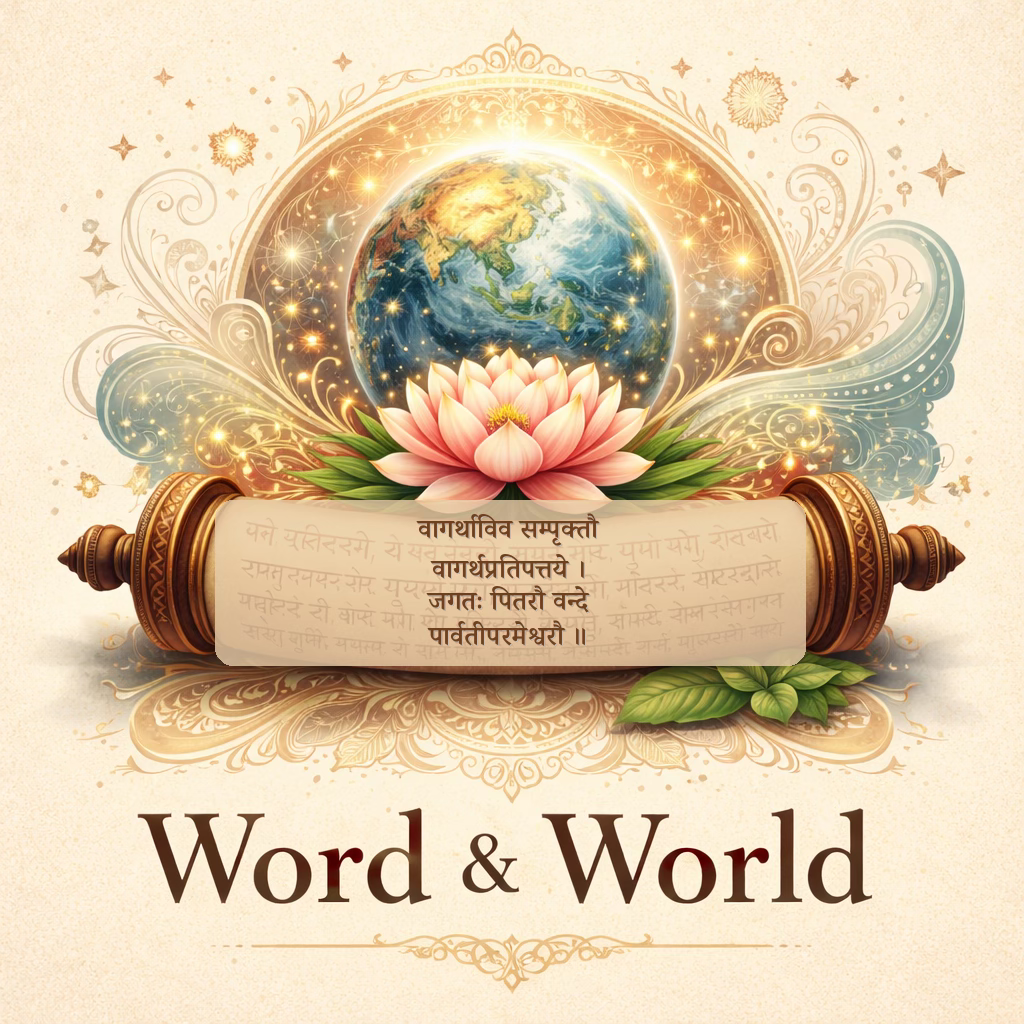
I am starting a new section called Word & World.
The idea came from something I keep noticing in conversations around yoga and Indian traditions: many misunderstandings begin not with the practice itself, but with the words used to describe it. The language around yoga is everywhere now, yet the meanings behind those words are often far less clear than they appear.
Sometimes the issue begins with translation. A Sanskrit term gets matched with a quick English equivalent, and while that translation may capture part of the meaning, it rarely carries the full depth of the original. Words like dharma, karma, bhakti, or even yoga itself often fall into this category. They are familiar enough that people feel comfortable using them, but the world of meaning they belong to is much larger than a single translation can hold.
At other times the opposite happens. Instead of using the original word, people avoid it entirely. Sanskrit terms are replaced with modern language that feels more accessible or neutral. Yoga becomes “mindfulness,” bhakti becomes “devotional energy,” and dharma becomes “purpose.” These shifts are not always wrong, but they quietly reshape how the tradition is understood.
There is also a third situation that is becoming increasingly common. Modern labels are introduced into conversations about yoga and Indian traditions, often carrying assumptions that were not originally part of those traditions. Words like caste, nationalism, religion, appropriation, or even spirituality are used as if their meanings were universal and self-evident. But these terms come from particular historical and cultural contexts, and when they are applied too loosely they can create more confusion than clarity.
All of this made me realize that language itself deserves closer attention.
That is the purpose of Word & World.
This section begins with a simple premise: words are not just tools for communication. They carry entire frameworks of thought. A single term can hold assumptions about how life works, what practice is meant to achieve, how knowledge is transmitted, and how a tradition understands the relationship between the individual and the world.
When the word changes, the framework often changes with it.
Take the word yoga. In many places today it is used almost entirely in reference to posture practice. Yet in classical sources the word carries a much broader meaning involving discipline, transformation of the mind, and ultimately liberation. When the word is used in a narrower sense, the path it describes also begins to look narrower.
The same is true of words like bhakti, which is often treated simply as emotional devotion, even though the traditions surrounding it involve philosophy, theology, and rigorous practice. Or dharma, which is frequently translated as “duty” or “purpose,” while in many texts it refers to the sustaining order that holds both individual life and society together.
These differences may seem small at first, but over time they shape how people understand the tradition as a whole.
This section is not meant to be a dictionary or a technical glossary. Instead, each piece will take one word and stay with it long enough to explore the world it belongs to. Sometimes that word will be Sanskrit. Sometimes it may come from regional traditions, devotional literature, or philosophical texts. And sometimes it may be a modern English term that has become part of the conversation around yoga today.
The goal is not simply to define the word. The goal is to understand what comes with it.
Where does the word appear? How has it been used historically? What assumptions does it carry? What changes when it is translated, simplified, or replaced by another term? And what happens when that shift begins to influence how people practice or interpret the tradition?
These are the kinds of questions Word & World will explore. New essays in Word & World will be published every Sunday.
The series will begin with a short opening arc called The World Before Yoga. These first few posts will explore several foundational words that describe the broader intellectual and cultural landscape in which yoga traditions developed. Only after that will we turn to the word yoga itself and the vocabulary that surrounds it.
After that opening arc, we will turn to a series of Sanskrit terms that frequently appear in conversations about yoga, words many readers will already recognize, but whose meanings often run much deeper than their everyday usage suggests.
Because in the end, language is never just language.
The words we choose shape how traditions are explained, defended, criticized, and practiced. A small shift in wording can open deeper understanding, or it can quietly redirect an entire conversation.
That is why this section begins here.
With a single word.
And the world that comes with it.
Word & World begins soon.
Om Tat Sat
Trupti
SattvaSpired | Yoga in Essence
Beautifully said. Yoga and bhoga were never enemies only misunderstood when seen outside their original framework. Context is everything, and Sanskrit holds that context if we stay with it long enough.
I will look forward for this section. Western world more than often uses these half baked interpretation of Sanskrit words for convenience and the essence of these beautiful words get lost in translation. So thank you for shedding light on this topic